

Passive House Construction
The world's leading standard for energy efficiency and comfort
What is a Passive House?

Passive House (Passivhaus in German) is the world's most rigorous voluntary standard for energy-efficient construction. Developed in Germany in the 1990s and now recognized internationally, Passive House buildings use up to 90% less heating and cooling energy than conventional homes while delivering superior comfort, indoor air quality, and long-term durability. The standard isn't just about saving energy—it's about creating homes that perform exactly as designed, year after year, decade after decade.
Unlike conventional "energy-efficient" homes that rely on expensive mechanical systems to compensate for poor building performance, Passive House takes a different approach. By focusing on an ultra-efficient building envelope—the walls, roof, windows, and foundation—Passive House homes require minimal active heating or cooling to maintain comfortable temperatures year-round. This means lower utility bills, reduced environmental impact, and a home that stays comfortable even during power outages.
Achieving Passive House certification requires meeting strict performance criteria verified through energy modeling and on-site testing. Every detail matters: from the thickness and continuity of insulation to the precise installation of windows and the effectiveness of the ventilation system. The result is a home that doesn't just meet minimum code requirements—it exceeds them by such a wide margin that heating and cooling become almost an afterthought.
New Brunswick's Trusted Certified Passive House Tradesperson

As New Brunswick's trusted Certified Passive House Tradesperson, IJM Builders brings specialized training and proven expertise to every phase of your Passive House project. This rigorous international certification represents years of study in building science, energy modeling, air sealing techniques, and quality assurance—ensuring your home meets the world's most demanding energy efficiency standard.
From initial design and energy modeling through meticulous construction and final certification, we understand the technical requirements and attention to detail that Passive House demands. Our Red Seal craftsmanship combined with Passive House expertise means you're working with a builder who can deliver both exceptional quality and certified performance.
The Five Principles of Passive House
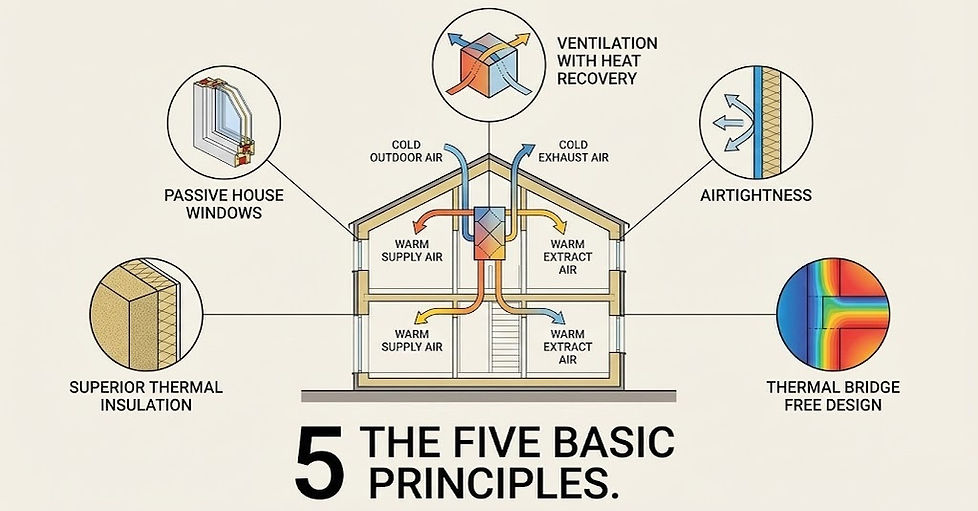
Passive House construction is built on five core principles that work together to create an ultra-efficient building envelope, dramatically reducing energy consumption while maximizing comfort and indoor air quality.
1.
Passive House Windows
Passive House windows are far more than just "energy-efficient" upgrades. They typically feature triple-pane glazing, insulated frames, and specialized spacers that dramatically reduce heat transfer. These windows maintain warm interior surface temperatures even on the coldest winter days, eliminating condensation and cold drafts near windows. The result is consistent comfort throughout your home and significant energy savings—windows are often the weakest point in a conventional home's thermal envelope, but in a Passive House, they become a strength.
3.
Airtightness
Uncontrolled air leakage is one of the biggest sources of energy loss in conventional homes. Passive House construction achieves exceptional airtightness through continuous air barriers, careful sealing of all penetrations, and meticulous attention to construction details. We verify airtightness through blower door testing, ensuring the building envelope meets the rigorous Passive House standard. This controlled envelope means no drafts, consistent temperatures, and the ventilation system works as designed.
2.
Ventilation with Heat Recovery
Fresh air is essential for healthy indoor air quality, but in conventional homes, opening windows or relying on mechanical ventilation means losing heated or cooled air. Passive House solves this with an energy recovery ventilator (ERV) or heat recovery ventilator (HRV) that continuously supplies fresh, filtered air while recovering up to 90% of the heat from outgoing air. This means you get constant fresh air without the energy penalty, and indoor air quality that far exceeds conventional homes—especially important for anyone with allergies or respiratory sensitivities.
4.
Superior Thermal Insulation
Passive House insulation goes well beyond code minimum requirements. We use significantly thicker insulation in walls, roofs, and foundations, ensuring continuous coverage without gaps or compression. The goal isn't just to meet a number—it's to create a building envelope that maintains comfortable interior temperatures with minimal energy input. Proper insulation also means warmer interior wall surfaces in winter and cooler surfaces in summer, contributing to year-round comfort and eliminating cold spots or overheated rooms.
5.
Thermal Bridge Free Design
Thermal bridges are weak points in a building envelope where heat escapes more easily—structural beams penetrating insulation, poorly detailed window installations, or balcony connections. In Passive House construction, we eliminate these thermal bridges through continuous insulation layers and careful detailing of critical junctions like corners, window frames, and roof-to-wall connections. This ensures the entire building envelope performs uniformly, preventing energy loss and cold spots throughout your home.
Benefits of a Passive House

Exceptional Comfort
Experience consistent temperatures in every room, year-round. No cold floors in winter, no overheated bedrooms in summer, and no drafts near windows or doors. Passive House homes maintain comfortable interior surface temperatures, creating a level of comfort that conventional homes simply can't match.

Dramatic Energy Savings
Passive House buildings use up to 90% less energy for heating and cooling compared to conventional homes. This translates to significantly lower utility bills month after month, year after year. You'll reduce your environmental footprint while enjoying long-term savings that make the initial investment worthwhile.

Healthier Indoor Air
Breathe easier with continuous fresh air circulation and superior filtration. The heat recovery ventilation system removes stale air, excess moisture, and indoor pollutants while bringing in filtered fresh air—without losing energy. This is especially beneficial for anyone with allergies, asthma, or respiratory sensitivities.
Our Passive House Expertise

As the region's trusted Certified Passive House Tradesperson, we bring specialized expertise that simply isn't available elsewhere in the Fredericton area. This certification represents rigorous training in the principles, methods, and quality control required to meet the world's most demanding energy efficiency standard. Combined with Red Seal Carpentry certification and over a decade of experience in high-quality construction throughout the Fredericton region, we understand both the science behind Passive House performance and the hands-on craftsmanship required to execute it flawlessly.
Building science knowledge sets Passive House construction apart from conventional building. It's not enough to simply follow plans—you need to understand how heat moves through building assemblies, how air barriers function, where thermal bridges occur, and how moisture behaves in highly insulated walls. This deep understanding informs every decision we make on site, from framing details to window installation to ventilation system placement. We don't just build to Passive House standards; we understand why those standards exist and how each detail contributes to overall performance.
We take on a limited number of Passive House projects each year because this level of construction demands focused attention and meticulous execution. Every connection, every seal, and every detail matters when building to this standard. Our approach combines traditional craftsmanship with cutting-edge building science, ensuring your Passive House is built right the first time—delivering the comfort, efficiency, and performance you expect for decades to come.
Frequently Asked Questions

Ready to Build Your Passive House?
Let's discuss your project. Schedule a consultation to get started.
or call us (506) 262-5913